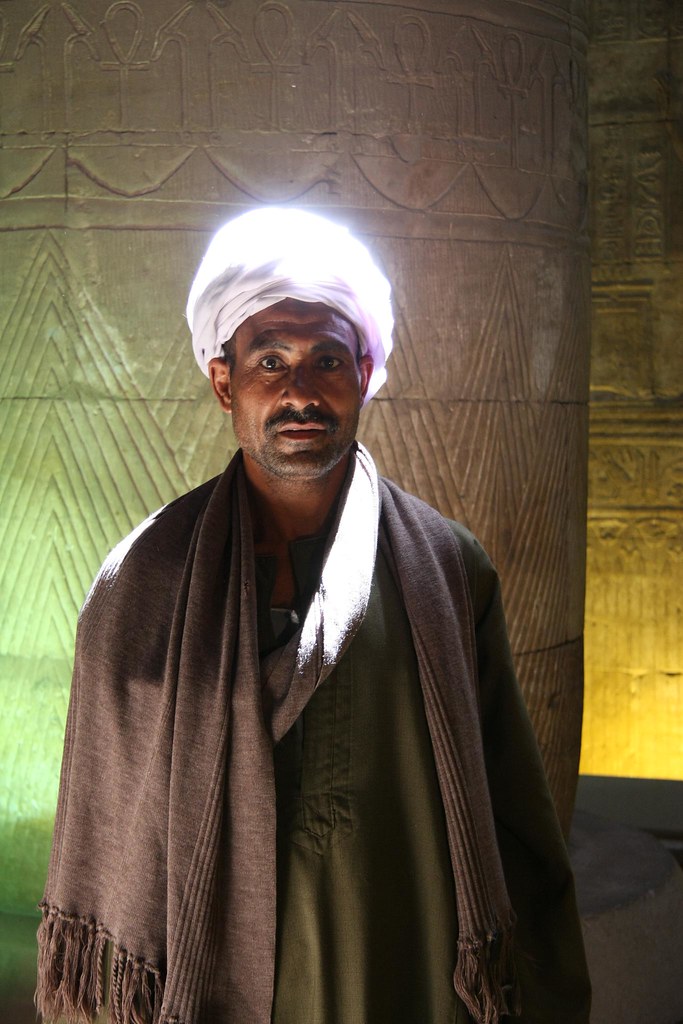
Illuminated By Sunlight At Edfu Temple, Egypt
 Photography by El-Branden Brazil
Photography by El-Branden Brazil
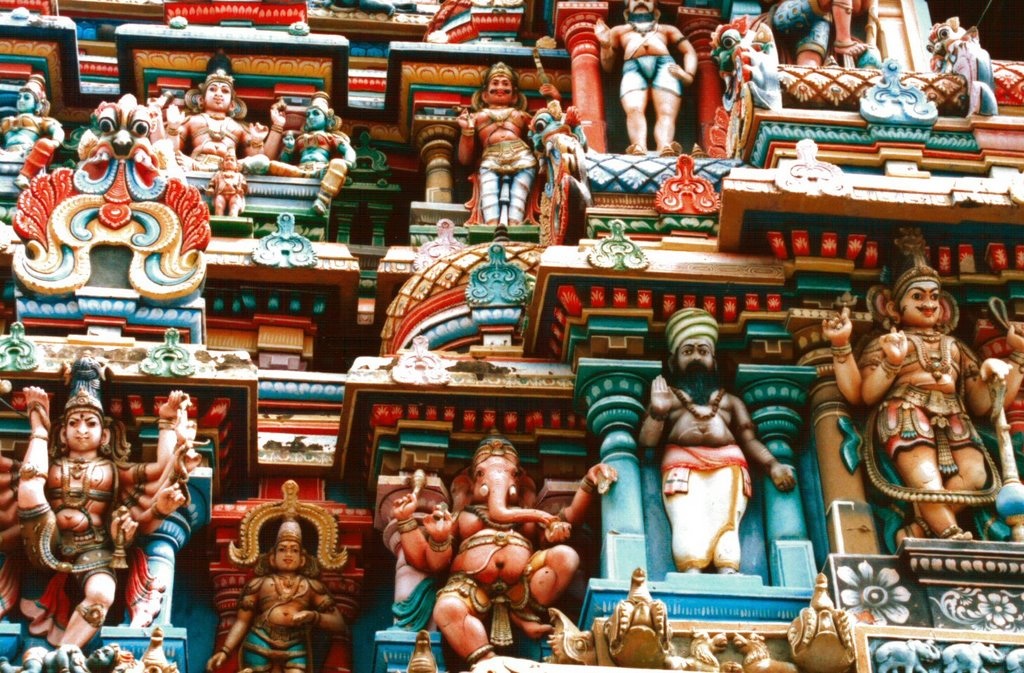
Colourful godly stuccos at Meenakshi Temple. Photography by El-Branden Brazil
In the southern Indian state of Tamil Nadu is the bustling, crowded city of Madurai. Within it, is one of Asia’s great wonders, the Meenakshi Temple. Dominating the city’s skyline, 12 gopurams (temple towers) burst out towards the skies, engraved with thousands upon thousands of colourful images of Hindu gods and scenes. The temple is devoted to the god, Shiva.
Temple Offerings Photography by El-Branden Brazil
The ground on which the current buildings are located, has been the focus of religious rites since the 7th. Century. Much of the grand architecture that defines the temple today, was constructed by the Nayaks during their tenure as rulers of Madurai from the Sixteenth to the Eighteenth Centuries.
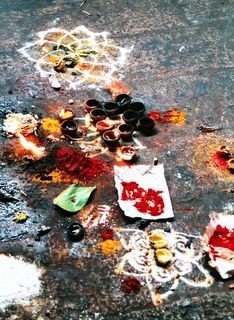
Within the walls of the complex are many small temples, where offerings of oil, incense, colourful powders, candles and flowers are placed.
There are several different sanctums that the worshipper passes through. The inner sanctum is a space for only Hindus to enter. Becoming disorientated by the vast complex, I accidently entered into this space. It was poorly lit and extremely atmospheric.
A large statue of Ganesh, illuminated by candles, caught my eye. As I was preparing to take a photograph, I was soon made aware of my mistake, when a sadhu (holy man) shouted at me to leave. Another man, came to me, and politely told me that I was not permitted to visit this area. I apologised appropriately and left quickly, so as not to further offend. However, I felt rather lucky and blessed to have entered the holy of holies and get more than a peek. I meant no harm nor disrespect.

Photography by El-Branden Brazil

Photography by El-Branden Brazil

Photography by El-Branden Brazil

Photography by El-Branden Brazil
As much as I love life in Japan, the pristine orderliness and routine often leaves my soul craving for the vibrancy and spontaneity of chaos found in other places. For myself, India is the perfect antidote. Every visit to this extraordinary land, has been an experience that touches a myriad of emotions, in a way that challenges an individual like nowhere else.
India has a diverse population of one billion, that consists of both a massive rapidly growing bourgeois, as well as people living in poverty on a scale that is hard to match anywhere else. Out from these contrasting ways of life is a society that simultaneously exists in a multitude of realities. With such extraordinary variance, it is surprising that any kind of semblance of order can be achieved. And yet, India functions as it has always done, through local ingenuity.
Perhaps, the most pervading aspect of the country is the religiosity of life there. The majority of Indians are adherents to Hinduism, but other religions, such as Sikhism, Buddhism, Jainism and Islam, have a wide following. For the most part, members of the various faiths have tended to live together peacefully, but occasionally, tensions do flare between the different communities.
India has always been attractive to those fond of spiritual exploration. Of course, everywhere are the symbols and temples of devotion that one would expect to find. Yet, India’s powerful invocation of the mystical, comes not from these, but rather from the contrasts that are to be found, such as extremes in beauty and ugliness, poverty and wealth, vibrancy and starkness. On every street that is walked, we are forced to accommodate stimuli that are both pleasing and disturbing.
It is often said that 50% of travellers hate India, whilst 50% love it. For myself, I very much fall into the latter group. That is not to say that I do not sympathise with the other group’s sense of discomfort, but rather I find the “discomfort” to be part of the wonderful challenge that India presents.
India is a unique gift to us all, and should be experienced at least once. When you return back to your home countries, you will be forever changed, and you will never forget the magic of Mother India.

Photography by El-Branden Brazil
Photography by El-Branden Brazil
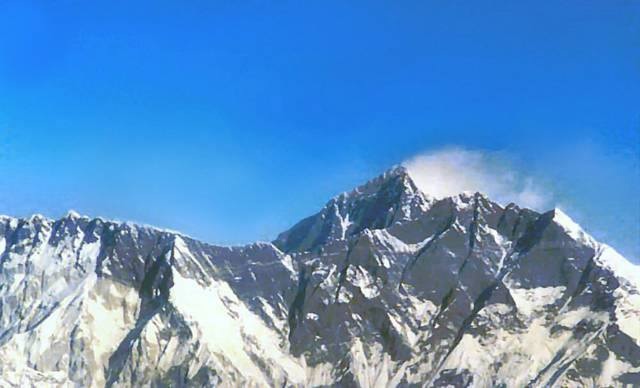
There, Mount Everest stood, nobly towering above the many, many white ridges and peaks of the Himalaya. Our small plane crawled along the seemingly endless wall of mountains that suddenly jut, without impromptu, from the low hills and plains of the Nepalese landscape.
Jason and I had spent an exhausting, but rewarding week trekking in the Annapurna region. On our return to Kathmandu, the call of Everest enchanted us. Due to a lack of time, it was impossible to trek to the base camp on this trip. Instead, we decided to take up the opportunity of flying with Royal Nepal Airlines, for a thirty-minute glimpse of the giant mountain.
At the time, the Maoist insurgency was causing some difficulties in the country. On several occasions while we were there, they enforced national strikes, which meant that public transport, shops and other facilities were forced to close for business, out of fear of violent retribution from the rebels.
On the day of our flight, all taxis were brought to a stand still, making it very difficult to predict whether we could get to the airport from the Kathmandu Guesthouse, downtown. Luckily, a bus organised by the airline, came to pick us up. The alternative was to pay high prices for an unscrupulous gangster to drive us there.
We waited for a while at the airport, surrounded by the usual ragbag of tourists. One Englishman sat in a corner, with his much younger Filipino wife coddling him like a baby. Finally, we boarded our small propeller aircraft. As our plane climbed altitude, we could see the wonderful, timeless roofs and spires of Kathmandu and its many temples.
Human structures quickly gave way to the brown, grassy hills of the upper plains, and then the unforgettable entrance of the majestic Himalaya range. Nothing can prepare you for the scale and magnificence of the sight. No photo or beautifully written prose can capture the almost mystical rapture that can be engaged by looking upon the spectacle with one’s own eyes. There is nothing like it anywhere else I have been.
The airplane bobbed up and down upon the varying air currents outside. Soon, Everest came into view, with a wisp of cloud wrapped around its peak. Unfortunately, the windows in the passengers’ cabin were tinted brown, so the natural colour of the surroundings were hard to perceive. However, the captain allowed us to file into the cockpit individually, where we were permitted to take photographs through clear glass.
To the inhabitants of the region, Everest is called by the much more beautiful-sounding name, Chomolungma – Goddess Mother of the World. As tantalising as our view of her was, she seemed drowned among the many other high peaks. There was a certain dissatisfaction in the glimpse we were given, perhaps due to the ease in which we were allowed to view her. I felt like a cheat, undeserving of seeing her full glory. It was as if the mountains around, shielded her from our arrogance for dare looking down on her, as we cruised by in the comfort of our airplane.
I had not felt like this in the Annapurna, where a long, arduous trek had humbled me like a rite of initiation, permitting me to the overwhelming sight of that splendid mountain range’s sheer, white walls. Like Everest, the Annapurna’s magic would have been diminished if observed from the air. Only from the ground can humans tap into their primeval faculty of mind, where the mountain connects as it has always done for millennia. It is by no accident that mountains have been the inspiration for so much spiritual faith.
As I gazed out towards Everest, I made a promise that next time, I would trek to the base camp, where I will be forced to prostrate and look up upon her beauty. Only then, when I am made aware of my own insignificance, can true appreciation and gratitude be appropriately graced upon her.

Photography by El-Branden Brazil
“Before we understood science, it was natural to believe that God created the universe, but now science offers a more convincing explanation. What I meant by ‘we would know the mind of God’ is we would know everything that God would know if there was a God, but there isn’t. I’m an atheist” – Stephen Hawking
This word “God” is a semantic hurdle. The word can mean many things to many people, including simply or complexly, the universe itself in abstraction. It is just a label applied to the great mysteries that abound, just as the phrase “the Big Bang” is. Words try to find meaning in the darkness. They are conveniences.
I do agree that science can discover great, underlying truths, and perhaps the mind of “God”. We may even discover if the universe is a hologram, and that we are the universe itself, enfolded infinitely. We may even discover, as some maverick scientists postulate now, that the universe is a simulation. We may discover then, that in the beginning was, indeed, the word.
What the mathematics of science brings to Truth is accuracy over the flowery flourishes of metaphor used by mystics. Yet, we must not be mistaken in thinking that the insights of mystics are any less valid and valuable for understanding Truth. I see no difference between the Big Bang and the Aborigines’ Rainbow Serpent dreaming the world into existence. No difference at all, except the words used.
I have always believed that mathematics may well be the language of God. However, the words of great mystics should not be diminished any less in their value for understanding Truth. There is much wisdom, poetry and insight to be found in the metaphors of mystics. Even the mystics themselves though have repeatedly pointed out the inadequacy of words to express the insights they have gained from their experiences of the divine. The Buddha was himself reluctant to try and explain what he had gained, because he doubted that his awakening could be adequately expressed through words. The Sufi mystic, Rumi said, “If I could repeat it, people passing by would be enlightened and go free.”
Arthur C. Clark once wrote, “Any sufficiently advanced technology is indistinguishable from magic.” In defining something, we often fail to see things as they truly are. Indeed, if I must choose labels, I much prefer the poeticness of magic, over the coolness of technology, regardless of if they are an indistinguishable thing. Perhaps it is the poetry of the term God that makes it such an appealing label for the great unknown.
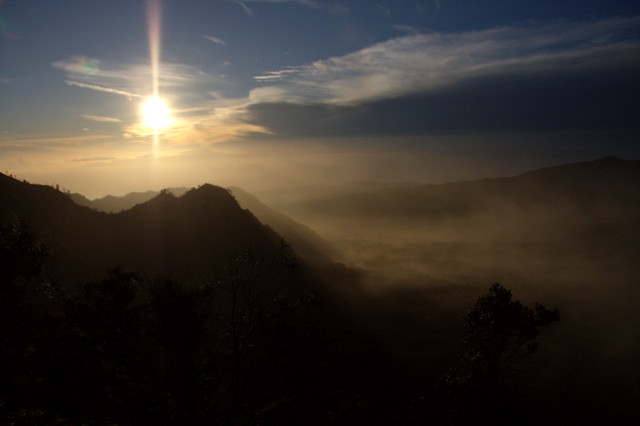
Dawn In Borom, Indonesia
Photography by El-Branden Brazil
 El-Branden Brazil