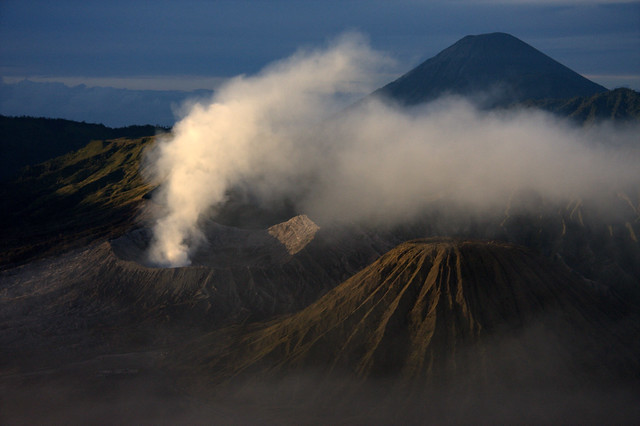
Mount Bromo, Indonesia
Photography by El-Branden Brazil
Photography by El-Branden Brazil
Photography by El-Branden Brazil
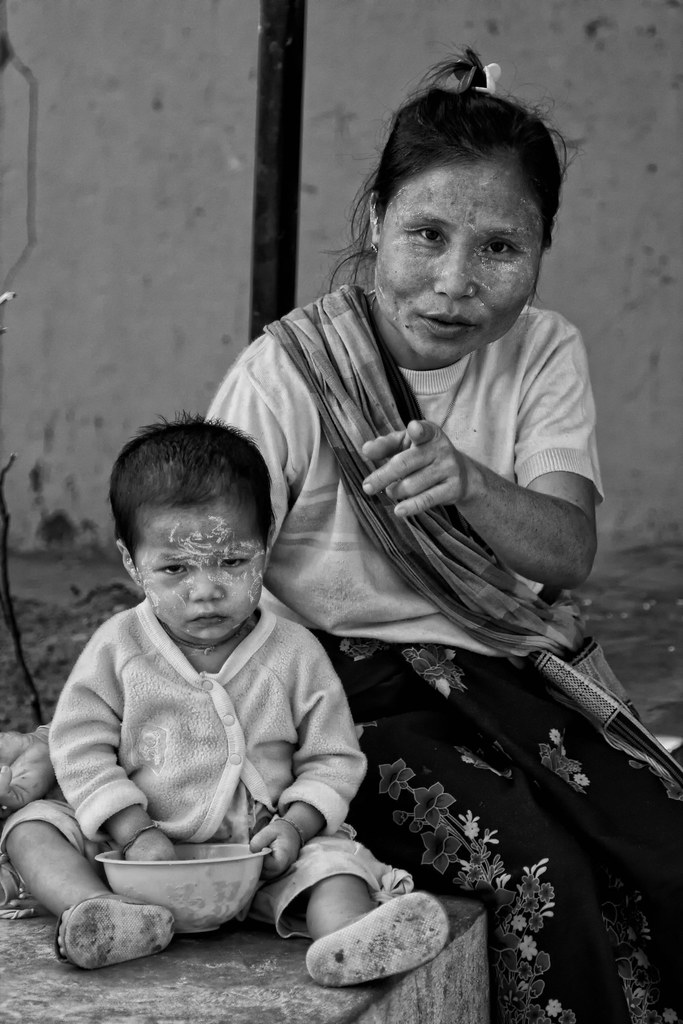
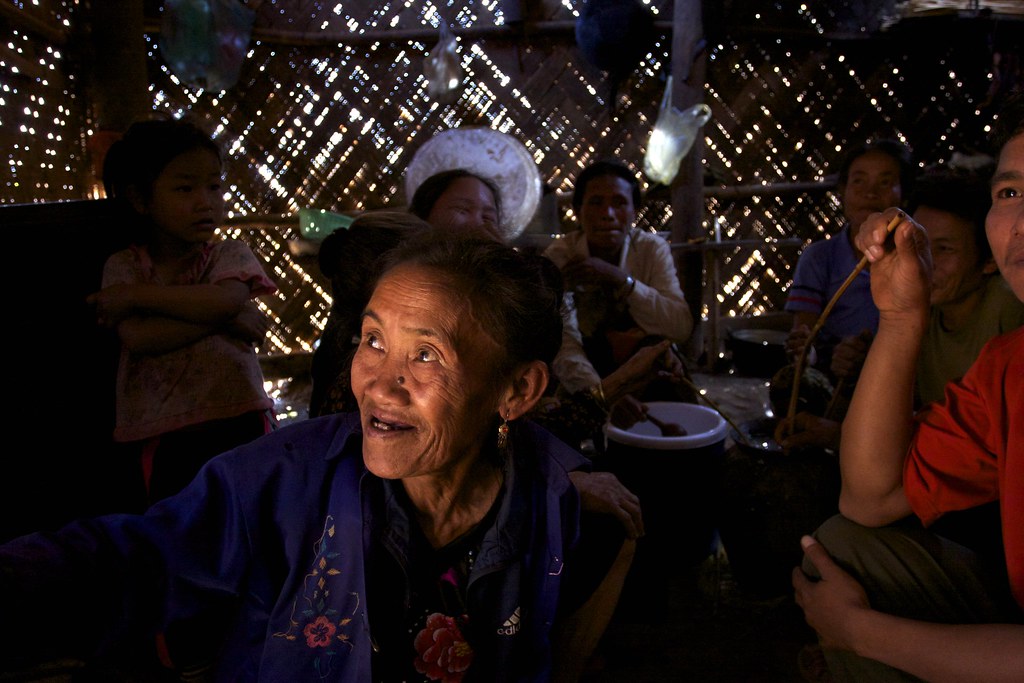
The Mae Tao Clinic (MTC), founded and directed by Dr. Cynthia Maung, providing free health care for refugees, migrant workers, and other individuals who cross the border from Burma to Thailand. People of all ethnicities and religions are welcome at the Clinic. Its origins go back to the student pro-democracy movement in Burma in 1988 and the brutal repression by the Burmese regime of that movement. The fleeing students who needed medical attention were attended in a small house in Mae Sot.
Since 1989 MTC has grown, from that one small house to a large complex of simple buildings that provide a wide variety of health services to different groups of people. Today it serves a target population of approximately 150,000 on the Thai-Burma border. Exact numbers are hard to calculate because of the fluidity of the population. About 50% of those who come to MTC for medical attention are migrant workers in the Mae Sot area; the other 50% travel cross-border from Burma for care.
Mae Tao Clinic Objectives:
1. To provide health services for displaced Burmese populations along the Thailand-Burma border.
2. To provide initial training of health workers and subsequent corollary medical education.
3. To strengthen health information systems along the border.
4. To improve health, knowledge, attitudes, and practices within local Burmese populations.
5. To promote collaboration among local ethnic health organizations.
6. To strengthen networking and partnering with international health professionals and institutions.
Please support this vital service. maetaoclinic.org/
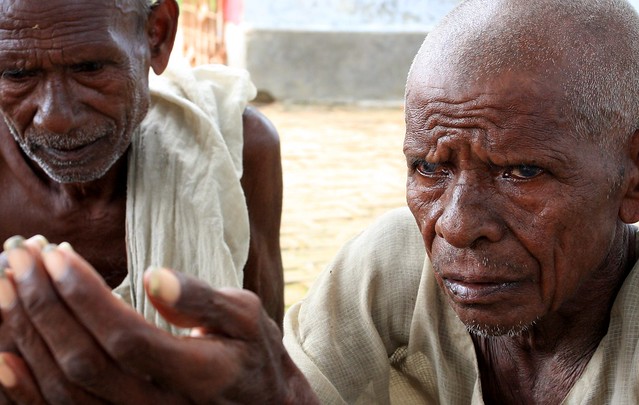
Capitalism right now is a rigged game, where only a few have the privilege to write and rewrite the rules in whatever way suits them. As their wealth increases, and they buy themselves into the politicians’ pockets, the rest of us see social benefits in health, education and welfare stripped down, salaries reduced, bills increasing, fears growing and many families unable to adequately feed themselves.
I have no problem with the idea that if you work hard, then you should be rewarded. However, I do have a problem with individuals driven merely by an unquenchable, psychotic thirst for money, who place higher value on greed than compassion for their fellow humans. I have a problem with those of limited talent, but due to birthright, are allowed unfettered privilege. I also have a problem with individuals who are paid millions and millions of dollars in pay-offs and bonuses, whilst smirking and sneering at the rest of us, as we are exploited, sold-out and perennially broke. I despise that those who almost destroyed the global economy, neither see jail cells nor are reprimanded, but instead see their wealth grow on the back of our misery; misery they helped to create. Worst of all, are the scum who find profit in wars.
All I wish to see are mechanisms that are fairer, compassionate and allow for a more even distribution of wealth. The sooner this unbridled capitalism becomes aware that, just like tooth fairies, there is no such thing as sustainable, infinite exponential growth, the sooner we can reel things back in, protect the planet, end poverty and raise sustainably the living standards to a level better for all.
Photography by El-Branden Brazil
Photography by El-Branden Brazil
Photography by El-Branden Brazil
When I was a young child, I began to have an interest in Buddhism. This started from curiosity about the strange, mysterious Eastern statues that cluttered my late uncle’s house in London. He had a fine collection of Buddhas from all corners of Asia; each displaying their individual cultural design. There was something intriguing in their benevolent smile that just enticed me to learn more.
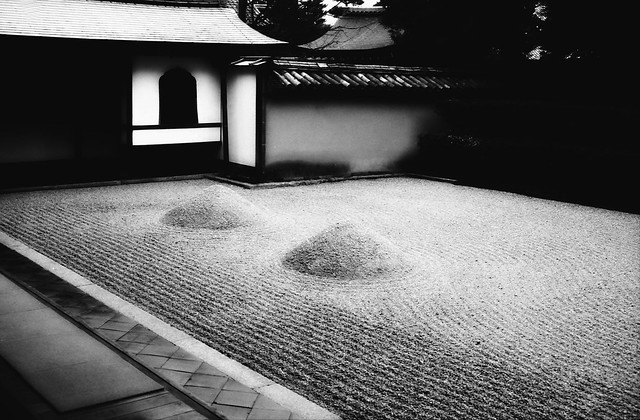
At 12, I started to build a small collection of books devoted to mysticism around the world. I prized a set of encyclopaedias, called Man, Myth & Magic, which covered every topic regarding occultism, religion, legends and Anthropology. Within, were a grand array of images that to this day remain potent in my mind; particularly those of Buddhist monks meditating at Zen gardens in Japan.
In a secondhand bookshop in London, I purchased my first book on Zen, written by Christmas Humphreys. It was a slender volume, with an image of an Asian tiger on the front. The next book I purchased on the subject, again in London, was a delightful tome by Shunryu Suzuki, Zen Mind, Beginner’s Mind. I found this book to be a clear gateway into understanding the point – if there is indeed a point – to Zen.
In those young years, Zen had enormous appeal to me, even though I had much to learn. I adored the design and art of Zen, with their pristine, clear gardens of raked gravel and precisely placed rocks. It was exotic for a small English boy dreaming of travelling to far-flung places. I kept this interest quiet, as I was a non-Catholic at a Catholic school.
At long last, I finally completed my school studies, graduated from university and I was now an adult free in the big old world. Within six months of graduation, I moved to Japan. Inevitably, high on my priority list of places to visit in this most curious of countries were the Zen temples of Kamakura. It was a childhood dream to see with my very own eyes the scenes that had attracted me so much in the pages of my books.
In no time, I was heading away from Tokyo to my first Zen temple, on what now seems like such an innocent adventure into the unknown. I got off the train in Kita-Kamakura and took a short walk to a nearby temple, called Enkaku-ji. I felt myself pulsating with joy to see a real living Zen temple.
Enkaku-ji was selected by the Hojo clan, towards the end of the Kamakura period – when the town was the capital of Japan – as one of the five most important Zen temples. The Rinzai school of Zen is practiced within, and to this day, it remains an important place for the study of Zazen (meditation).
As I moved closer to the main central complex, enamoured with delight, I came across a small door, with an improvised sign stuck to it. Written on a piece of paper, in English, were the clear words ‘Come in.’ My mind was abuzz with excitement that just maybe I would finally meet a real Zen monk within, who would take me under his wing and lead me to Satori (instant enlightenment). I clasped the small ring handle and turned it, full of trepidation and curiosity…
…The door opened and at this point, a monk, dressed in black robes, came screaming towards me, ‘GET OUT! GET OUT!’ It was not the moment I had dreamt of as a child! I quickly made a retreat, feeling ejected, rejected and dejected that I had been scorned by a holy man for opening a door.
As I walked away, I started to chuckle to myself, as I realised what a classic Zen lesson I had been taught. Instantly, the ‘exotic’ which had intoxicated my mind, and had become a distraction from a truer understanding of Buddhism, was now instantly removed. For the first time, I recognised that the tranquil, idealised monks in my Western books were, in fact, no different than I. To this day, I thank that monk for treating me in such a brusque manner.

Photography by El-Branden Brazil
High quality A3 size prints are available for purchase at my online store.
I call myself a Buddhist, but I believe that such labels are irrelevant. I cannot be certain, but I like to believe that Christ was a Buddha, although he was not a Buddhist.
The reality is that such labels only divide us in our mutual search for Truth. Calling yourself a Christian, Muslim, Hindu, Jain, Pagan, Buddhist, Atheist, Agnostic… whatever, does not give you the privilege to Truth alone. To investigate reality, we must first engage with it, looking beyond the preconceived, conditioned cultures we are indoctrinated into. We must step out of the comfort zones we inhabit, open our minds and embrace the possibility that we might well be wrong. Just search, question and seek absolute truths, even if you never find them, because they do exist.
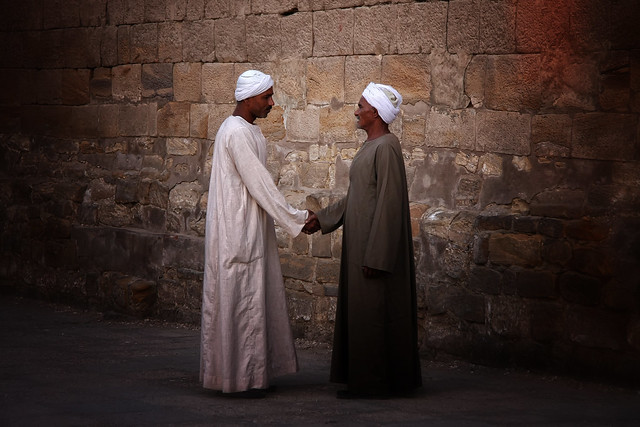
Surely, whilst we may ALL be wrong in what we believe in, the least we can do, in this vast, unanswered moment in space and time, is to hug and love our brothers and sisters of different faith. Our faiths might be unprovable, but LOVE AND COMPASSION ARE ABSOLUTE, because we have all seen the results they bring. The abstract dimensions of faith should be less of a priority, whilst the direct actions of love and compassion amplified, because, regardless of faith, these are qualities that bring positive effects to all.
Photography by El-Branden Brazil
Photography by El-Branden Brazil

Photography by El-Branden Brazil
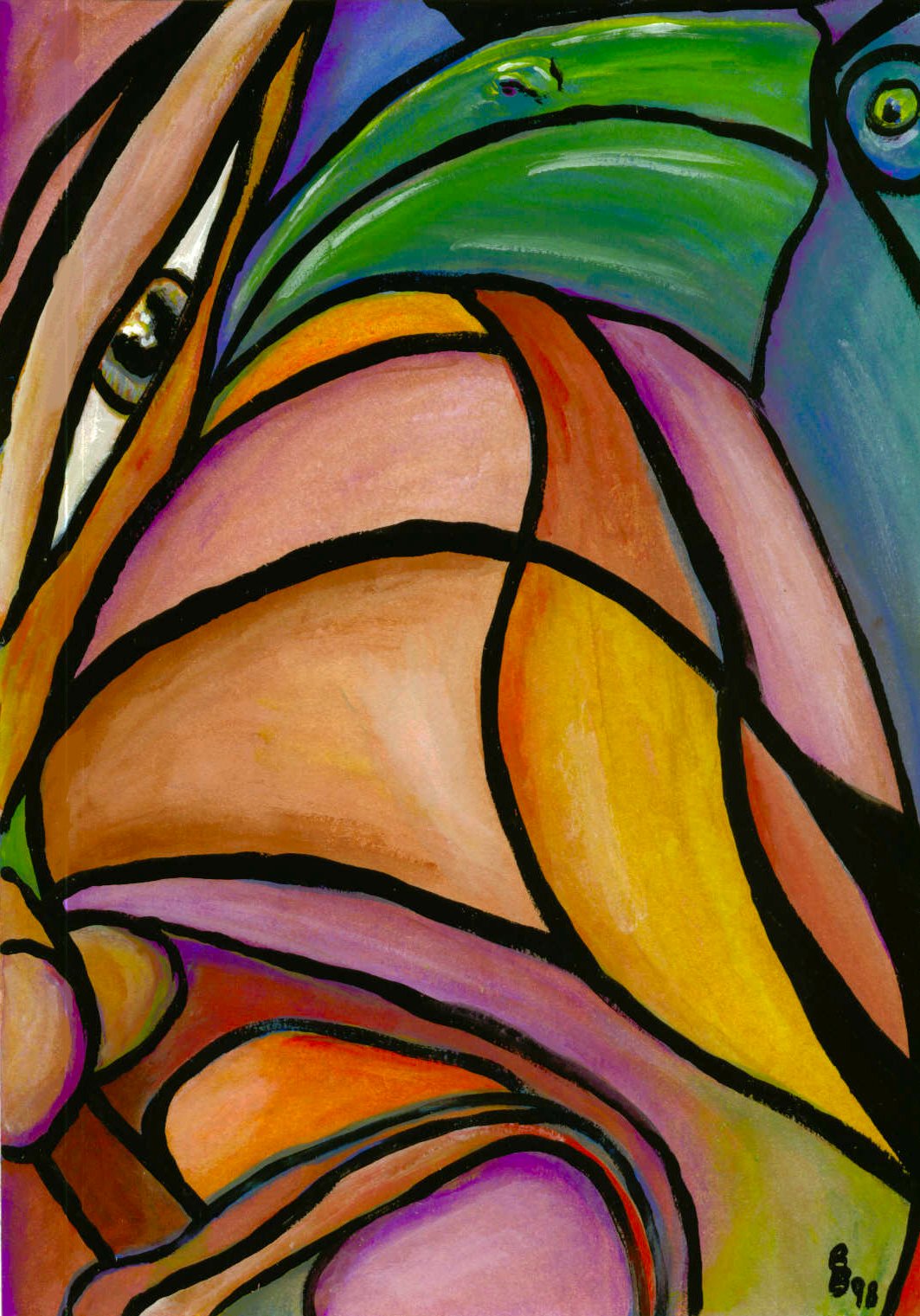
The following two poems were written in 1998. The second poem, Alternative Realities, is an abridged version of the first. The painting, Birdman, was also created in 1998.
REALITY INSECURITIES
The Aria ascended –
Claiming Rights and Giving Honour
To my Visions and Conjectures
In all its graceful turns:
Its pitches, its rises, its fluctuating rhymes –
Bound my mind from doing painful solemn time.
And yet, how foolish is my mind
That I can think I know
Not what is out beyond the hills,
But what lies out beyond the eye?
Reality twists from back and forth
In its cylindrical, distant tangled webs,
While the River flows, tingles, ebbs
So quietly on beyond all sense.
– El-Branden Brazil
ALTERNATIVE REALITIES
Fluctuating Rhymes –
their time,
their signs.
My mind I know –
the hills,
the eye,
and forth
the webs of their deceit.
And forth and forth
the distant river soars.
And forth and forth
until there is no more.
– El-Branden Brazil
Painting by El-Branden Brazil
 El-Branden Brazil