El-Branden Brazil

Photographer, Writer & Mystic Traveller

Posts tagged ‘Asian’

Mystical Encounters Of The Unexpected Kind

ramana_wideWhilst I was visiting Kochi in southern India, in 2004, I purchased a book, A Search For Secret India by Paul Brunton. It is a wonderfully nostalgic read, as it was written back in 1933. The book charts the adventures of the author in his quest to find genuine gurus and purveyors of Truth. What attracted me to the book, was the backcover’s claim that Mr Brunton finally discovered a true master. Regardless, the book was an enchanting travel companion.

As my journey in India was coming to a close, I found myself in delightful Pondicherry. I had reached a point where I was too close to Chennai to make any further long distance excursions, but I did not want to spend all my remaining time in either Pondicherry or Chennai. I asked some of the tsunami relief volunteers I had worked with, if they recommended any places to visit. They suggested that I go to Thiruvannamalai, which is located about two and a half hours drive inland from Pondicherry, because it is home to one of Hinduism’s holiest temples. I had no knowledge of this place, but it seemed conveniently located for my return journey to Chennai.

The night before my departure, I arranged for a car to take me to Thiruvannamalai. The Hindu man who helped arrange my driver, asked me if I was visiting the ashram (a spiritual hermitage or a monastery). I had no idea which ashram he was talking about, but rapidly our conversation evolved into one concerning mystical issues. I was immediately taken by the tone of this enigmatic and fascinating man. As I was leaving, he grabbed both my hands, and with deep conviction, asked for God to touch me. It was unexpected and very potent.

The next morning, a driver was there waiting for me at my hotel. When I got into the car, he asked where I was staying in Thiruvannamalai. Before I could even answer, he suggested the ashram. Since I had not yet organised a potential hotel to stay, I agreed to be dropped off at the mysterious ashram that I had no knowledge of at all. At least when I stayed at Amachi’s ashram during that Christmas, I knew of her movement.

As we approached Thiruvannamalai, I was immediately struck by the dominating mountain of Arunachala – a giant rocky peak of red and grey stone. In my ignorance, I did not realise that I was at one of the holiest Hindu sites, where the god, Lord Shiva, is thought to reside. Pilgrims climb the steep, stony peak barefooted each day.

In the shadow of the mountain, is the impressive Arunachala temple. It is very similar in design and scale to the temples found in Madurai, except the towers remain in their natural stone shades, as opposed to the usually gaudy-painted variety.

We finally arrived at the enigmatic ashram. I paid my driver and headed through the gates. As to be expected, I discovered the usual Indian-garbed Westerners, as I walked up to the office. I asked for accomodation, but was abruptly told that without a reservation it was impossible to stay. The manner was very curt, so I decided to leave immediately. I was, to say the least, unimpressed. I took an auto rickshaw back into town, and managed to get a basic, but very clean room at the friendly Trishul Hotel, which is located very closely to the temple.

After strolling about the vibrant town, I settled in for the night with my engrossing book, A Search For Secret India. I was flicking through the back pages, when suddenly the word “Arunachala” caught my eye. As I read further, the guru who had so impressed Paul Brunton in the 1930’s, was none other than Sri Ramana Maharshi, the guru whose ashram I had briefly visited that day. Suddenly, Brunton’s book came alive, as he described places that were all around me. I had to find out more about this guru who I knew so little about.

In Brunton’s book, he describes astounding experiences shared with Maharshi, who would meditate for hours a day. According to various biographical sources, it seems that Maharshi had been profoundly moved by an experience he had when he was 16, where he was given an insight into the nature of death. After his mystical revelation, against the wishes of his parents, he travelled from Madurai to Arunachala, where he remained until his death in 1950. He desired no followers, gifts or support, other than donations of food, and spent his younger years in a tiny cave on the mountain. Gradually, this charismatic man soon gained a reputation for his incomparable insights, and a small, basic ashram was built for him, at the base of Arunachala.

Brunton, who had searched across India for men of divine wisdom, finally found Maharshi, and was immediately taken by this great man. What impressed him enormously, was Maharshi’s lack of interest in acquiring disciples of any type. People who shared space with Maharshi, were often touched by some sort of exceptional vibration that would imbue a taste of enlightenment.

This certainly engaged my interest, and I was particularly curious about the manner in which I had ended up in this town. There were so many synchronistic moments that seemed to have some underlying reason for I being here. Of course, it could also be down to chance and coincidence, but the magic of India had intoxicated me with spiritual potentials. Instead of staying only a couple of days, I had to extended my time.

Recently UpdatedWhen I returned to the ashram the next day, I was immediately aware of how simple and small it was, compared to the grandiosity of the other ashrams I had visited. This was not a place designed to impress or convert people; it was rather a humble place of devotion and meditation. Even the Westerners there, seem like a calmer, less phony group. Perhaps, the teachings of Maharshi are so precise that there is no room for the luxury of phoniness.

I must admit, as I sat next to the hall where Brunton had experienced such an overwhelming connection with Maharshi, all those years back in 1932, I felt that this was the closest that I have perhaps ever come to a truly enlightened man, even though he had passed away so long ago.

The motivation that drove Maharshi was entirely selfless and unique, with none of the self-promotion that follows so many gurus. Maharshi’s teachings, as I rudimentarily understand them, are entirely in accordance with the deepest insights to be found in all religions. He does not promote a particular religion, but rather a way forward for attaining happiness. What an honour it was to discover one of those rare lights of humanity.

I later met the Indian man who had been curt with me previously when I arrived, and found him to be charming and informative. Walking around the ashram undisturbed, it gave me enormous pleasure to find the spots where Brunton had experienced incidents so long ago. The calm of that humble ashram will remain forever with me, and I hope that I will once again visit.
Ascending Mount Fuji

Photography by El-Branden Brazil

Photography by El-Branden Brazil

The majestic peak of Mount Fuji represents the Japanese like no other natural feature. This almost perfect volcanic cone stands watch over Tokyo, revealing itself often during the dry winter months.

Whilst not a giant mountain on the scale of the Himalayan peaks, it does measure 3776 meters, so whilst accessible for trekkers, it is high enough that it requires respect.

Between the months of June to September, the mountain opens to people driven to climb to its peak. Other times of year are off limits to anyone other than expert mountaineers; brave enough to face its icy slopes and fierce weather conditions.

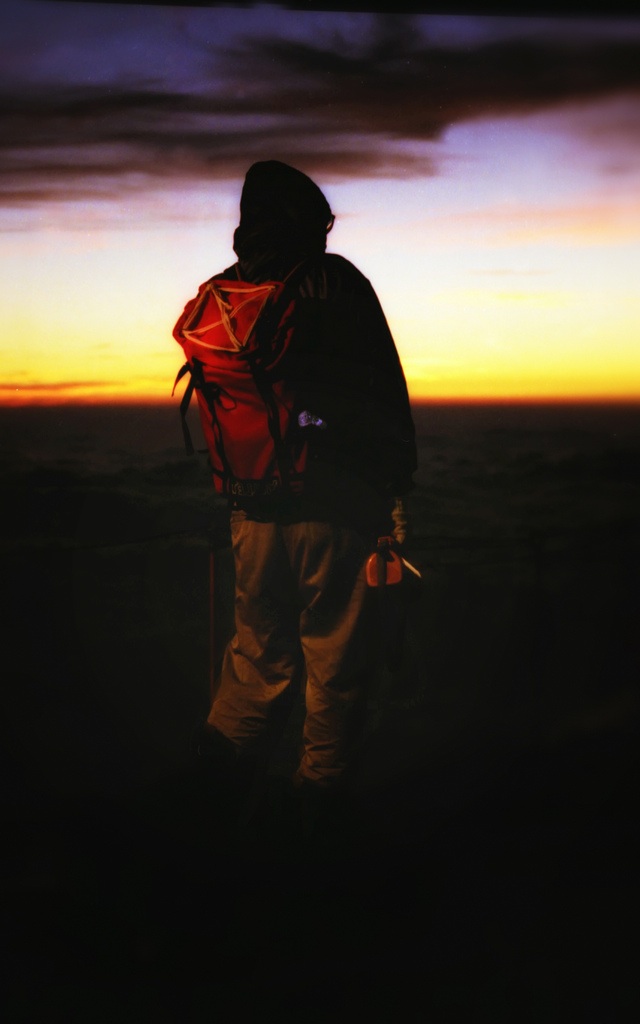
Most summer climbers attempt the challenge during the night, so that the dawn can be witnessed from the summit. Whilst the path leading up is fairly straightforward, it is recommended that all climbers wear sturdy hiking boots with good ankle support, as well as a daypack to carry warmer clothes for the peak, where the temperatures drop enormously from the summer humidity at the base.

Photography by El-Branden Brazil

Photography by El-Branden Brazil

Anyone assuming to scale this mountain with Romantic inclinations of doing so alone, will be sorely disappointed by the caterpillar of well-rigged Japanese hikers, crawling slowly and methodically up. Many of them stay at several of the over-priced, basic lodges that mark each of the nine stages to the top.

As the climber zigzags up to the seventh stage, the path suddenly alters into a more stimulating challenge, that requires clambering up on rocks, using chains to grab on to. The air also becomes thinner and thinner, especially after passing the 3000 meter mark. Some people carry small canisters of oxygen to avert altitude sickness. However, many of these people have finished their canisters well before they were needed.

The climb, whilst popular, is not as easy as many people assume it to be. It is a real mountain that requires stamina and perseverance. There are many who find the challenge too much, and backtrack down disappointed.

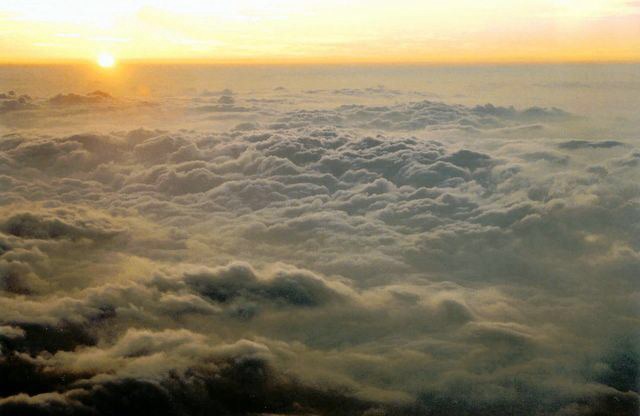
The legs become stiffer and the air cooler, as the night continues on. If the weather conditions are fine, a starlit sky of such clarity accompanies, with the dull blue clouds below, illuminated by the moon. The heart pounds ferociously and the lungs and throat become parched, but those moments of silence among the stars, when rest is called upon, are unforgettable.

Once at the peak, it is a surprise to find a large lodge, offering drinks, noodles and Japanese boiled foods, called Oden. It makes for a comfortable place to linger, whilst waiting for the twinkle of dawn to manifest.

Slowly, the darkness begins to fade, as the Sun begins its ascent upon the horizon. People assemble their cameras, many shaking with the chilling, biting wind. There, breaking above the clouds, a bright shaft of light pushes out. As this happens, everyone shouts out “Banzai! Banzai!”

Very soon, the sky is dominated by the brilliant sun, which illuminates Fuji, revealing the deep crater that leads to the heart of the mountain. In the daytime, the dormant volcano transforms into an entirely different environment, appearing very similar to Mars, with its red rock.

The descent down is the hardest part of the trek. Climbers without walking sticks, find themselves slipping repeatedly on the round, sharp volcanic stones that litter the winding pathway. The Sun also bakes those foolish enough not to bring a hat or sun block.

After a somewhat monotonous climb down, the exhausted climber finally reaches the bus stop, where the coaches come to ferry city dwellers back to the concrete jungle of modern Tokyo.

Photography by El-Branden Brazil

Photography by El-Branden Brazil

Burmese Mother & Infant At Mae Tao Clinic

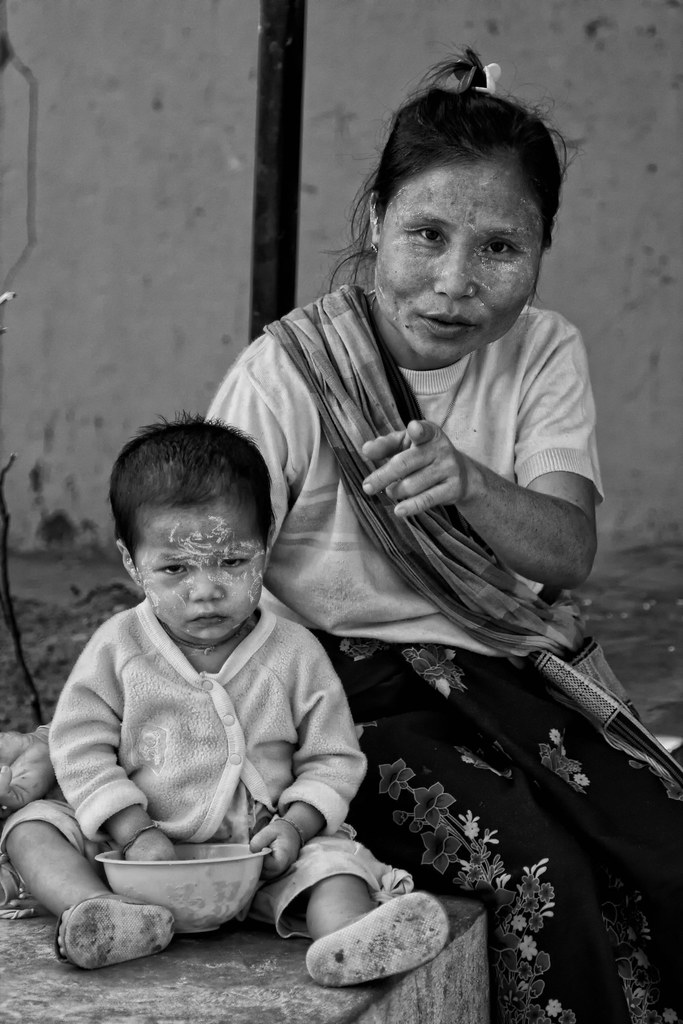
A Burmese Mother & Infant At Mae Tao Clinic
Photography by El-Branden Brazil

The Mae Tao Clinic (MTC), founded and directed by Dr. Cynthia Maung, providing free health care for refugees, migrant workers, and other individuals who cross the border from Burma to Thailand. People of all ethnicities and religions are welcome at the Clinic. Its origins go back to the student pro-democracy movement in Burma in 1988 and the brutal repression by the Burmese regime of that movement. The fleeing students who needed medical attention were attended in a small house in Mae Sot.

Since 1989 MTC has grown, from that one small house to a large complex of simple buildings that provide a wide variety of health services to different groups of people. Today it serves a target population of approximately 150,000 on the Thai-Burma border. Exact numbers are hard to calculate because of the fluidity of the population. About 50% of those who come to MTC for medical attention are migrant workers in the Mae Sot area; the other 50% travel cross-border from Burma for care.

Mae Tao Clinic Objectives:

1. To provide health services for displaced Burmese populations along the Thailand-Burma border.
2. To provide initial training of health workers and subsequent corollary medical education.
3. To strengthen health information systems along the border.
4. To improve health, knowledge, attitudes, and practices within local Burmese populations.
5. To promote collaboration among local ethnic health organizations.
6. To strengthen networking and partnering with international health professionals and institutions.

Please support this vital service. maetaoclinic.org/

Awakenings At A Zen Temple

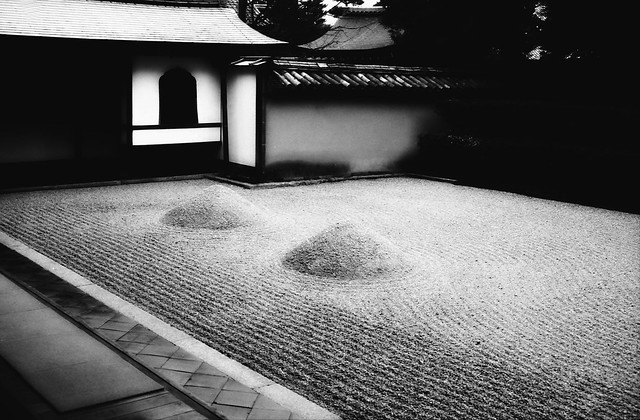
Zen Garden
Photography by El-Branden Brazil

When I was a young child, I began to have an interest in Buddhism. This started from curiosity about the strange, mysterious Eastern statues that cluttered my late uncle’s house in London. He had a fine collection of Buddhas from all corners of Asia; each displaying their individual cultural design. There was something intriguing in their benevolent smile that just enticed me to learn more.

At 12, I started to build a small collection of books devoted to mysticism around the world. I prized a set of encyclopaedias, called Man, Myth & Magic, which covered every topic regarding occultism, religion, legends and Anthropology. Within, were a grand array of images that to this day remain potent in my mind; particularly those of Buddhist monks meditating at Zen gardens in Japan.

In a secondhand bookshop in London, I purchased my first book on Zen, written by Christmas Humphreys. It was a slender volume, with an image of an Asian tiger on the front. The next book I purchased on the subject, again in London, was a delightful tome by Shunryu Suzuki, Zen Mind, Beginner’s Mind. I found this book to be a clear gateway into understanding the point – if there is indeed a point – to Zen.

In those young years, Zen had enormous appeal to me, even though I had much to learn. I adored the design and art of Zen, with their pristine, clear gardens of raked gravel and precisely placed rocks. It was exotic for a small English boy dreaming of travelling to far-flung places. I kept this interest quiet, as I was a non-Catholic at a Catholic school.

At long last, I finally completed my school studies, graduated from university and I was now an adult free in the big old world. Within six months of graduation, I moved to Japan. Inevitably, high on my priority list of places to visit in this most curious of countries were the Zen temples of Kamakura. It was a childhood dream to see with my very own eyes the scenes that had attracted me so much in the pages of my books.

In no time, I was heading away from Tokyo to my first Zen temple, on what now seems like such an innocent adventure into the unknown. I got off the train in Kita-Kamakura and took a short walk to a nearby temple, called Enkaku-ji. I felt myself pulsating with joy to see a real living Zen temple.

Enkaku-ji was selected by the Hojo clan, towards the end of the Kamakura period – when the town was the capital of Japan – as one of the five most important Zen temples. The Rinzai school of Zen is practiced within, and to this day, it remains an important place for the study of Zazen (meditation).

As I moved closer to the main central complex, enamoured with delight, I came across a small door, with an improvised sign stuck to it. Written on a piece of paper, in English, were the clear words ‘Come in.’ My mind was abuzz with excitement that just maybe I would finally meet a real Zen monk within, who would take me under his wing and lead me to Satori (instant enlightenment). I clasped the small ring handle and turned it, full of trepidation and curiosity…

…The door opened and at this point, a monk, dressed in black robes, came screaming towards me, ‘GET OUT! GET OUT!’ It was not the moment I had dreamt of as a child! I quickly made a retreat, feeling ejected, rejected and dejected that I had been scorned by a holy man for opening a door.

As I walked away, I started to chuckle to myself, as I realised what a classic Zen lesson I had been taught. Instantly, the ‘exotic’ which had intoxicated my mind, and had become a distraction from a truer understanding of Buddhism, was now instantly removed. For the first time, I recognised that the tranquil, idealised monks in my Western books were, in fact, no different than I. To this day, I thank that monk for treating me in such a brusque manner.