Buddha Masks In Kathmandu

Photography by El-Branden Brazil
Photography by El-Branden Brazil
Photography by El-Branden Brazil
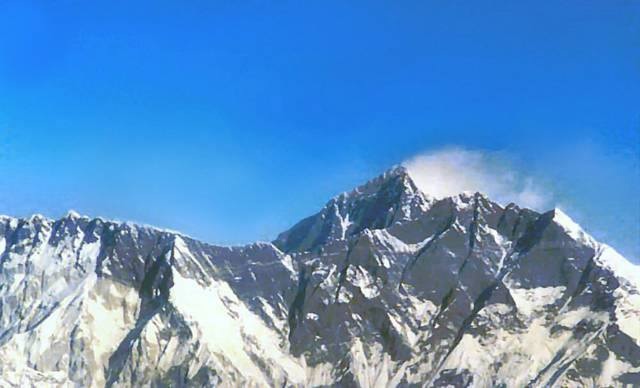
There, Mount Everest stood, nobly towering above the many, many white ridges and peaks of the Himalaya. Our small plane crawled along the seemingly endless wall of mountains that suddenly jut, without impromptu, from the low hills and plains of the Nepalese landscape.
Jason and I had spent an exhausting, but rewarding week trekking in the Annapurna region. On our return to Kathmandu, the call of Everest enchanted us. Due to a lack of time, it was impossible to trek to the base camp on this trip. Instead, we decided to take up the opportunity of flying with Royal Nepal Airlines, for a thirty-minute glimpse of the giant mountain.
At the time, the Maoist insurgency was causing some difficulties in the country. On several occasions while we were there, they enforced national strikes, which meant that public transport, shops and other facilities were forced to close for business, out of fear of violent retribution from the rebels.
On the day of our flight, all taxis were brought to a stand still, making it very difficult to predict whether we could get to the airport from the Kathmandu Guesthouse, downtown. Luckily, a bus organised by the airline, came to pick us up. The alternative was to pay high prices for an unscrupulous gangster to drive us there.
We waited for a while at the airport, surrounded by the usual ragbag of tourists. One Englishman sat in a corner, with his much younger Filipino wife coddling him like a baby. Finally, we boarded our small propeller aircraft. As our plane climbed altitude, we could see the wonderful, timeless roofs and spires of Kathmandu and its many temples.
Human structures quickly gave way to the brown, grassy hills of the upper plains, and then the unforgettable entrance of the majestic Himalaya range. Nothing can prepare you for the scale and magnificence of the sight. No photo or beautifully written prose can capture the almost mystical rapture that can be engaged by looking upon the spectacle with one’s own eyes. There is nothing like it anywhere else I have been.
The airplane bobbed up and down upon the varying air currents outside. Soon, Everest came into view, with a wisp of cloud wrapped around its peak. Unfortunately, the windows in the passengers’ cabin were tinted brown, so the natural colour of the surroundings were hard to perceive. However, the captain allowed us to file into the cockpit individually, where we were permitted to take photographs through clear glass.
To the inhabitants of the region, Everest is called by the much more beautiful-sounding name, Chomolungma – Goddess Mother of the World. As tantalising as our view of her was, she seemed drowned among the many other high peaks. There was a certain dissatisfaction in the glimpse we were given, perhaps due to the ease in which we were allowed to view her. I felt like a cheat, undeserving of seeing her full glory. It was as if the mountains around, shielded her from our arrogance for dare looking down on her, as we cruised by in the comfort of our airplane.
I had not felt like this in the Annapurna, where a long, arduous trek had humbled me like a rite of initiation, permitting me to the overwhelming sight of that splendid mountain range’s sheer, white walls. Like Everest, the Annapurna’s magic would have been diminished if observed from the air. Only from the ground can humans tap into their primeval faculty of mind, where the mountain connects as it has always done for millennia. It is by no accident that mountains have been the inspiration for so much spiritual faith.
As I gazed out towards Everest, I made a promise that next time, I would trek to the base camp, where I will be forced to prostrate and look up upon her beauty. Only then, when I am made aware of my own insignificance, can true appreciation and gratitude be appropriately graced upon her.
“Before we understood science, it was natural to believe that God created the universe, but now science offers a more convincing explanation. What I meant by ‘we would know the mind of God’ is we would know everything that God would know if there was a God, but there isn’t. I’m an atheist” – Stephen Hawking
This word “God” is a semantic hurdle. The word can mean many things to many people, including simply or complexly, the universe itself in abstraction. It is just a label applied to the great mysteries that abound, just as the phrase “the Big Bang” is. Words try to find meaning in the darkness. They are conveniences.
I do agree that science can discover great, underlying truths, and perhaps the mind of “God”. We may even discover if the universe is a hologram, and that we are the universe itself, enfolded infinitely. We may even discover, as some maverick scientists postulate now, that the universe is a simulation. We may discover then, that in the beginning was, indeed, the word.
What the mathematics of science brings to Truth is accuracy over the flowery flourishes of metaphor used by mystics. Yet, we must not be mistaken in thinking that the insights of mystics are any less valid and valuable for understanding Truth. I see no difference between the Big Bang and the Aborigines’ Rainbow Serpent dreaming the world into existence. No difference at all, except the words used.
I have always believed that mathematics may well be the language of God. However, the words of great mystics should not be diminished any less in their value for understanding Truth. There is much wisdom, poetry and insight to be found in the metaphors of mystics. Even the mystics themselves though have repeatedly pointed out the inadequacy of words to express the insights they have gained from their experiences of the divine. The Buddha was himself reluctant to try and explain what he had gained, because he doubted that his awakening could be adequately expressed through words. The Sufi mystic, Rumi said, “If I could repeat it, people passing by would be enlightened and go free.”
Arthur C. Clark once wrote, “Any sufficiently advanced technology is indistinguishable from magic.” In defining something, we often fail to see things as they truly are. Indeed, if I must choose labels, I much prefer the poeticness of magic, over the coolness of technology, regardless of if they are an indistinguishable thing. Perhaps it is the poetry of the term God that makes it such an appealing label for the great unknown.
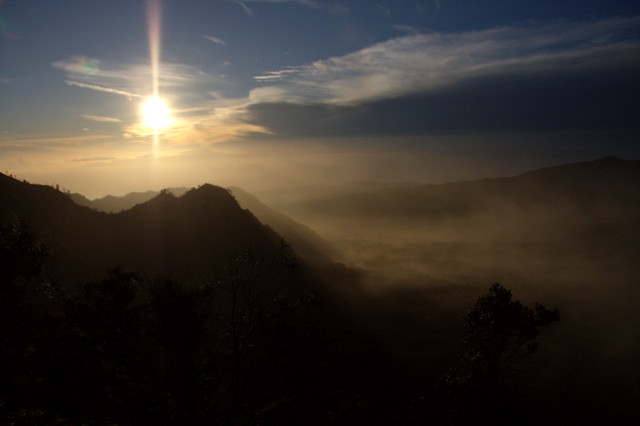
Dawn In Borom, Indonesia
Photography by El-Branden Brazil

Photography by El-Branden Brazil

Photography by El-Branden Brazil

Photography by El-Branden Brazil
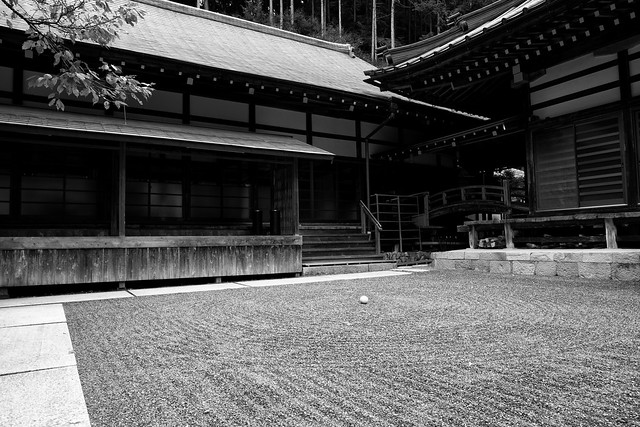
Touke-in Temple, Shizouka, Japan
Photography by El-Branden Brazil

Photography by El-Branden Brazil
Photography by El-Branden Brazil
 Whilst I was visiting Kochi in southern India, in 2004, I purchased a book, A Search For Secret India by Paul Brunton. It is a wonderfully nostalgic read, as it was written back in 1933. The book charts the adventures of the author in his quest to find genuine gurus and purveyors of Truth. What attracted me to the book, was the backcover’s claim that Mr Brunton finally discovered a true master. Regardless, the book was an enchanting travel companion.
As my journey in India was coming to a close, I found myself in delightful Pondicherry. I had reached a point where I was too close to Chennai to make any further long distance excursions, but I did not want to spend all my remaining time in either Pondicherry or Chennai. I asked some of the tsunami relief volunteers I had worked with, if they recommended any places to visit. They suggested that I go to Thiruvannamalai, which is located about two and a half hours drive inland from Pondicherry, because it is home to one of Hinduism’s holiest temples. I had no knowledge of this place, but it seemed conveniently located for my return journey to Chennai.
The night before my departure, I arranged for a car to take me to Thiruvannamalai. The Hindu man who helped arrange my driver, asked me if I was visiting the ashram (a spiritual hermitage or a monastery). I had no idea which ashram he was talking about, but rapidly our conversation evolved into one concerning mystical issues. I was immediately taken by the tone of this enigmatic and fascinating man. As I was leaving, he grabbed both my hands, and with deep conviction, asked for God to touch me. It was unexpected and very potent.
The next morning, a driver was there waiting for me at my hotel. When I got into the car, he asked where I was staying in Thiruvannamalai. Before I could even answer, he suggested the ashram. Since I had not yet organised a potential hotel to stay, I agreed to be dropped off at the mysterious ashram that I had no knowledge of at all. At least when I stayed at Amachi’s ashram during that Christmas, I knew of her movement.
As we approached Thiruvannamalai, I was immediately struck by the dominating mountain of Arunachala – a giant rocky peak of red and grey stone. In my ignorance, I did not realise that I was at one of the holiest Hindu sites, where the god, Lord Shiva, is thought to reside. Pilgrims climb the steep, stony peak barefooted each day.
In the shadow of the mountain, is the impressive Arunachala temple. It is very similar in design and scale to the temples found in Madurai, except the towers remain in their natural stone shades, as opposed to the usually gaudy-painted variety.
We finally arrived at the enigmatic ashram. I paid my driver and headed through the gates. As to be expected, I discovered the usual Indian-garbed Westerners, as I walked up to the office. I asked for accomodation, but was abruptly told that without a reservation it was impossible to stay. The manner was very curt, so I decided to leave immediately. I was, to say the least, unimpressed. I took an auto rickshaw back into town, and managed to get a basic, but very clean room at the friendly Trishul Hotel, which is located very closely to the temple.
After strolling about the vibrant town, I settled in for the night with my engrossing book, A Search For Secret India. I was flicking through the back pages, when suddenly the word “Arunachala” caught my eye. As I read further, the guru who had so impressed Paul Brunton in the 1930’s, was none other than Sri Ramana Maharshi, the guru whose ashram I had briefly visited that day. Suddenly, Brunton’s book came alive, as he described places that were all around me. I had to find out more about this guru who I knew so little about.
In Brunton’s book, he describes astounding experiences shared with Maharshi, who would meditate for hours a day. According to various biographical sources, it seems that Maharshi had been profoundly moved by an experience he had when he was 16, where he was given an insight into the nature of death. After his mystical revelation, against the wishes of his parents, he travelled from Madurai to Arunachala, where he remained until his death in 1950. He desired no followers, gifts or support, other than donations of food, and spent his younger years in a tiny cave on the mountain. Gradually, this charismatic man soon gained a reputation for his incomparable insights, and a small, basic ashram was built for him, at the base of Arunachala.
Brunton, who had searched across India for men of divine wisdom, finally found Maharshi, and was immediately taken by this great man. What impressed him enormously, was Maharshi’s lack of interest in acquiring disciples of any type. People who shared space with Maharshi, were often touched by some sort of exceptional vibration that would imbue a taste of enlightenment.
This certainly engaged my interest, and I was particularly curious about the manner in which I had ended up in this town. There were so many synchronistic moments that seemed to have some underlying reason for I being here. Of course, it could also be down to chance and coincidence, but the magic of India had intoxicated me with spiritual potentials. Instead of staying only a couple of days, I had to extended my time.
 When I returned to the ashram the next day, I was immediately aware of how simple and small it was, compared to the grandiosity of the other ashrams I had visited. This was not a place designed to impress or convert people; it was rather a humble place of devotion and meditation. Even the Westerners there, seem like a calmer, less phony group. Perhaps, the teachings of Maharshi are so precise that there is no room for the luxury of phoniness.
I must admit, as I sat next to the hall where Brunton had experienced such an overwhelming connection with Maharshi, all those years back in 1932, I felt that this was the closest that I have perhaps ever come to a truly enlightened man, even though he had passed away so long ago.
The motivation that drove Maharshi was entirely selfless and unique, with none of the self-promotion that follows so many gurus. Maharshi’s teachings, as I rudimentarily understand them, are entirely in accordance with the deepest insights to be found in all religions. He does not promote a particular religion, but rather a way forward for attaining happiness. What an honour it was to discover one of those rare lights of humanity.
I later met the Indian man who had been curt with me previously when I arrived, and found him to be charming and informative. Walking around the ashram undisturbed, it gave me enormous pleasure to find the spots where Brunton had experienced incidents so long ago. The calm of that humble ashram will remain forever with me, and I hope that I will once again visit.
 El-Branden Brazil