A Buddhist Nun Ties A String Of Faith, Cambodia

Photography by El-Branden Brazil
Photography by El-Branden Brazil
“Before we understood science, it was natural to believe that God created the universe, but now science offers a more convincing explanation. What I meant by ‘we would know the mind of God’ is we would know everything that God would know if there was a God, but there isn’t. I’m an atheist” – Stephen Hawking
This word “God” is a semantic hurdle. The word can mean many things to many people, including simply or complexly, the universe itself in abstraction. It is just a label applied to the great mysteries that abound, just as the phrase “the Big Bang” is. Words try to find meaning in the darkness. They are conveniences.
I do agree that science can discover great, underlying truths, and perhaps the mind of “God”. We may even discover if the universe is a hologram, and that we are the universe itself, enfolded infinitely. We may even discover, as some maverick scientists postulate now, that the universe is a simulation. We may discover then, that in the beginning was, indeed, the word.
What the mathematics of science brings to Truth is accuracy over the flowery flourishes of metaphor used by mystics. Yet, we must not be mistaken in thinking that the insights of mystics are any less valid and valuable for understanding Truth. I see no difference between the Big Bang and the Aborigines’ Rainbow Serpent dreaming the world into existence. No difference at all, except the words used.
I have always believed that mathematics may well be the language of God. However, the words of great mystics should not be diminished any less in their value for understanding Truth. There is much wisdom, poetry and insight to be found in the metaphors of mystics. Even the mystics themselves though have repeatedly pointed out the inadequacy of words to express the insights they have gained from their experiences of the divine. The Buddha was himself reluctant to try and explain what he had gained, because he doubted that his awakening could be adequately expressed through words. The Sufi mystic, Rumi said, “If I could repeat it, people passing by would be enlightened and go free.”
Arthur C. Clark once wrote, “Any sufficiently advanced technology is indistinguishable from magic.” In defining something, we often fail to see things as they truly are. Indeed, if I must choose labels, I much prefer the poeticness of magic, over the coolness of technology, regardless of if they are an indistinguishable thing. Perhaps it is the poetry of the term God that makes it such an appealing label for the great unknown.
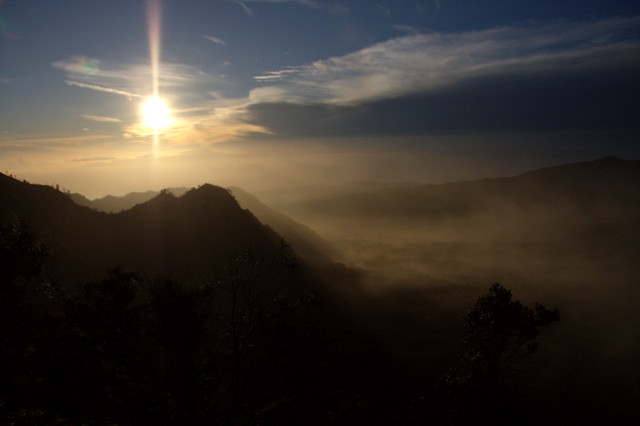
Dawn In Borom, Indonesia
Photography by El-Branden Brazil
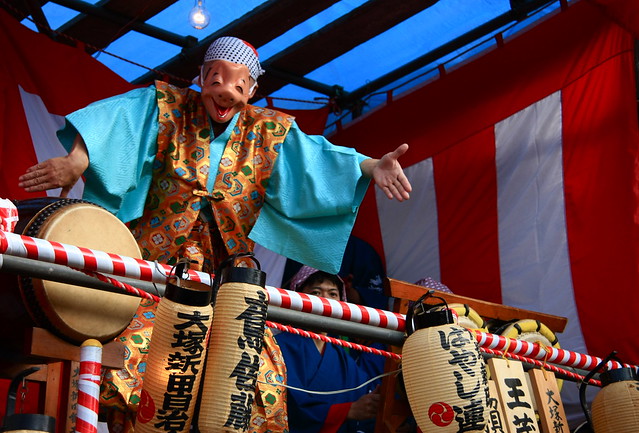
Photography by El-Branden Brazil
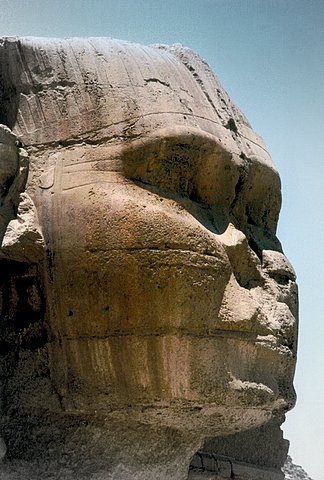
Photography by El-Branden Brazil
Time’s stalwart guardian, the Sphinx, has seemingly forever sat upon the Giza Plateau. In fact, according to most estimates, this enigmatic creation is believed to have been built when Khafra’s pyramid was constructed between 2558 to 2532 BC.
The term sphinx comes from the Greek for strangler; although it has been suggested that the word originates from the ancient Egyptian phrase shesep ankh (living image).
Many scholars have surmised that the face of this fantastical creature is, in fact, an image of Pharaoh Khafra himself; although this has still yet to be confirmed. It certainly seems plausible, as the Sphinx stands at the end of a ritual causeway that leads up to Khafra’s pyramid.
Recently, there has been a lot of contention regarding the accepted age of the Sphinx. Some scientists have suggested that the Sphinx may belong to an older civilisation, dating as far back as 12,000 years. These controversial conclusions were founded upon the level of erosion that has affected the main body of the sculpture. The maverick scientists who promote these theories, believe that the erosion lines could only have appeared during a period of high moisture in the region, pre-dating the age of the Pharaohs by thousands of years, during a period that followed the last great Ice Age. If this could be proven, then the history of civilisation would have to be radically updated.
Traditional Egyptologists are not swayed by such ideas, as they are not by the predictions of American mystic, Edgar Cayce, who had visions of a lost library of ancient wisom laying within the Sphinx. There have been several legitimate excavations to discover if, indeed, a space within exists. Towards the back of the sandstone statue near its tail, a small, hollow chamber was discovered, but nothing that would hint towards a larger, more important inner complex.
With a maximum height of 20 metres, and a length of 73 metres, the Sphinx instantly enthralls the visitor with both powerful mythology and ancient history. There are efforts to preserve it from the increasing threat of Cairo’s pollution, which is causing the Sphinx to suffer from stone’s equivalent of cancer. How much reconstruction should be done, has been a source of great contention, but with the current environmental assault, if work is not continued, this fabled art piece will be challenged to survive another millennium.
Photography & Report by El-Branden Brazil

Photography by El-Branden Brazil
Whilst sitting with my Zen Master, something suddenly occurred to me:
Human life is exactly like a leaf on a tree. In Spring, it buds into existence. In Summer, it reaches its full potential, bright and green. In Autumn, it begins to lose it’s vibrancy, turning brown and falling to the ground below. In Winter, it decomposes and becomes one with the earth again.
This metaphor is perhaps obvious, but the difference is in how a human life and a leaf go through these changes. A leaf is without consciousness, and passes through the process of existing, very, very quietly and being what it simply is. Humans, by contrast, manifest great anguish as we grasp desperately to what will inevitably be lost. If only we could remain silent like a leaf, being the thing as it is, with the sweet clarity of Truth and without the grandiose delusions of self.

Photography by El-Branden Brazil

Photography by El-Branden Brazil
I will be having an exhibition of my photography, in collaboration with brilliant Japanese Butoh dancer, Masahiro Nakanishi, from October 24th to October 26th, in Tokyo. Please come if you can.



Photography by El-Branden Brazil

Photography by El-Branden Brazil
 El-Branden Brazil