El-Branden Brazil

Photographer, Writer & Mystic Traveller

Archive for ‘September, 2014’

Make A Difference

Let’s all work for peace, and encourage an end to all suffering.
Let’s continue to campaign for those who need help and support.
Let’s change the world with positivity and love.
Let’s find friendship with those we thought could never be our friends.
Let’s be tolerant and appreciative of the diversity of lifestyles and faiths.
Let’s try to become informed about the things we don’t understand.
Let’s make bridges between all nations.
Let’s be resolute in finding inner peace and beauty.
Let’s be wise in every decision we make.
Let’s be generous in spirit and heart to those in need.

– El-Branden Brazil

Ashin Sopaka Arrives At The Dump
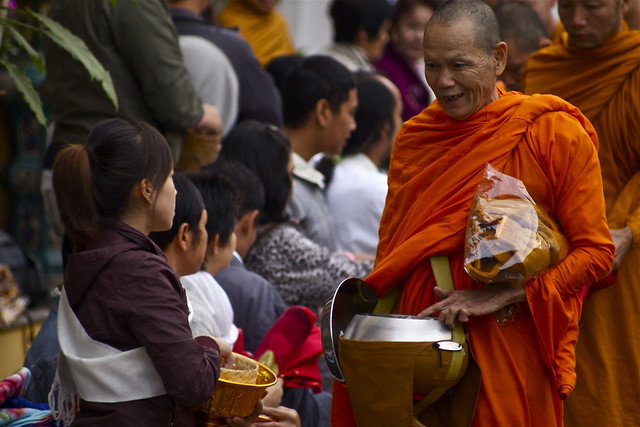
Ashin Sopaka, one of the leaders of Burma’s Saffron Revolution, has been supporting Burmese refugees and migrant workers, who live on a dump in Mae Sot, Thailand.
Photography by El-Branden Brazil

Napoleon & The Mystery Within The Pyramid

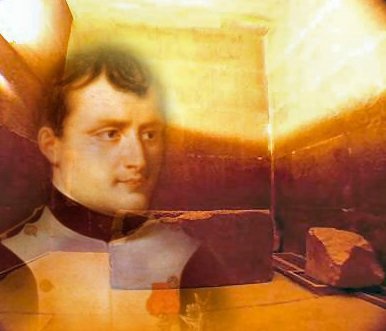
imageIn 1798, Napoleon Bonaparte embarked on a military expedition of Egypt. Like so many throughout history, he was drawn to the mystique of the Pharoahs.

Napoleon was an influential force in the birth of Egyptology. Accompanying his troops, were also engineers, surveyors, artists and archaeologists, who were required to document the great ruins of the ancient Egyptian civilisation. This led to an explosion of interest in all things Egyptian throughout Europe at the time; an interest that has never waned.

Regardless of the myths that abound, Napoleon was not responsible for the destruction of the Sphinx’s nose. According to legend, Napoleon ordered his troops to aim at the nose for target practice. In actual fact, the nose was most likely removed by a Sufi, named Sa’im al-dahr, in 1378. The reason for this disfigurement was a response to the continuing Sphinx worship that many Egyptians at the time still practiced. In Islam, idol worship is disallowed. A recent event that echoes this, was the destruction of the Bamiyan Buddhas in Afghanistan by the Taliban.

The inner sanctum of the Pyramids drew Napoleon in, like so many before him and since. After exploring the chambers of Khufu’s Great Pyramid, Napoleon requested to be left alone in the King’s Chamber. When he finally emerged, he is reported to have been extremely shaken and shocked by something within. When asked what had happened, he refused to discuss it and insisted that the incident never be spoken of again.

A friend, who visited Napoleon in his final days, asked him to tell him the secret of that day. Napoleon was ready to speak, but then shook his head and declined. Enigmatically, he responded, ‘No, what’s the use. You’d never believe me.’

Aleister Crowley

Aleister Crowley

Much fanciful speculation has been written about what occurred. Some have suggested that Napoleon was given a vision of his future.

Interestingly, myth also speaks of Alexander the Great spending a night within the chamber. Although, this has never been substantiated, it is very likely that Alexander would have visited the Pyramids, during his brief period in Egypt.

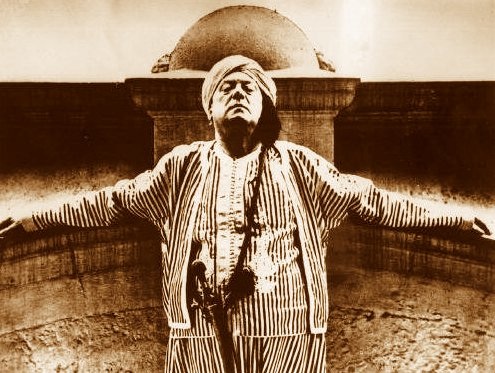
In his autobiography, the great occultist, Aleister Crowley reported a strange event that occurred within the Pyramid, with his wife, Rose, in 1904.

‘The King’s Chamber was aglow as if with the brightest tropical moonlight. The pitiful dirty yellow flame of the candle was like a blasphemy, and I put it out. The astral light remained during the whole of the invocation and for some time afterwards, though it lessened in intensity as we composed ourselves to sleep. For the rest, the floor of the King’s Chamber is particularly uncompromising. In sleeping out on rocks, one can always accommodate oneself more or less to the local irregularities, but the King’s Chamber reminded me of Brand; and I must confess to having passed a very uncomfortable night. I fear me dalliance had corrupted my Roman virtue. In the morning the astral light had completely disappeared and the only sound was the flitting of the bats.’

Shortly afterwards in Cairo, Rose began to channel an entity called Aiwass, which provided Crowley with his occult magnum opus, The Book Of Law. Over three days, he scribbled down the magickal instructions as they were communicated to him. From this point on, Crowley followed the dictum: ‘Do what thou wilt shall be the whole of the law.’

Did Napoleon and Crowley’s strange experiences within the King’s Chamber actually happen? Perhaps, within, great ancient secrets await for those receptive enough to gain access. However, it is also highly possible that both these men of extreme personality became intoxicated by the tantalising mystery that surrounds the Pyramids. Quite clearly, the Pyramids were built with the spiritual in mind, but the reality of the experiences that both men had, is but theirs alone.

Mystical Encounters Of The Unexpected Kind

ramana_wideWhilst I was visiting Kochi in southern India, in 2004, I purchased a book, A Search For Secret India by Paul Brunton. It is a wonderfully nostalgic read, as it was written back in 1933. The book charts the adventures of the author in his quest to find genuine gurus and purveyors of Truth. What attracted me to the book, was the backcover’s claim that Mr Brunton finally discovered a true master. Regardless, the book was an enchanting travel companion.

As my journey in India was coming to a close, I found myself in delightful Pondicherry. I had reached a point where I was too close to Chennai to make any further long distance excursions, but I did not want to spend all my remaining time in either Pondicherry or Chennai. I asked some of the tsunami relief volunteers I had worked with, if they recommended any places to visit. They suggested that I go to Thiruvannamalai, which is located about two and a half hours drive inland from Pondicherry, because it is home to one of Hinduism’s holiest temples. I had no knowledge of this place, but it seemed conveniently located for my return journey to Chennai.

The night before my departure, I arranged for a car to take me to Thiruvannamalai. The Hindu man who helped arrange my driver, asked me if I was visiting the ashram (a spiritual hermitage or a monastery). I had no idea which ashram he was talking about, but rapidly our conversation evolved into one concerning mystical issues. I was immediately taken by the tone of this enigmatic and fascinating man. As I was leaving, he grabbed both my hands, and with deep conviction, asked for God to touch me. It was unexpected and very potent.

The next morning, a driver was there waiting for me at my hotel. When I got into the car, he asked where I was staying in Thiruvannamalai. Before I could even answer, he suggested the ashram. Since I had not yet organised a potential hotel to stay, I agreed to be dropped off at the mysterious ashram that I had no knowledge of at all. At least when I stayed at Amachi’s ashram during that Christmas, I knew of her movement.

As we approached Thiruvannamalai, I was immediately struck by the dominating mountain of Arunachala – a giant rocky peak of red and grey stone. In my ignorance, I did not realise that I was at one of the holiest Hindu sites, where the god, Lord Shiva, is thought to reside. Pilgrims climb the steep, stony peak barefooted each day.

In the shadow of the mountain, is the impressive Arunachala temple. It is very similar in design and scale to the temples found in Madurai, except the towers remain in their natural stone shades, as opposed to the usually gaudy-painted variety.

We finally arrived at the enigmatic ashram. I paid my driver and headed through the gates. As to be expected, I discovered the usual Indian-garbed Westerners, as I walked up to the office. I asked for accomodation, but was abruptly told that without a reservation it was impossible to stay. The manner was very curt, so I decided to leave immediately. I was, to say the least, unimpressed. I took an auto rickshaw back into town, and managed to get a basic, but very clean room at the friendly Trishul Hotel, which is located very closely to the temple.

After strolling about the vibrant town, I settled in for the night with my engrossing book, A Search For Secret India. I was flicking through the back pages, when suddenly the word “Arunachala” caught my eye. As I read further, the guru who had so impressed Paul Brunton in the 1930’s, was none other than Sri Ramana Maharshi, the guru whose ashram I had briefly visited that day. Suddenly, Brunton’s book came alive, as he described places that were all around me. I had to find out more about this guru who I knew so little about.

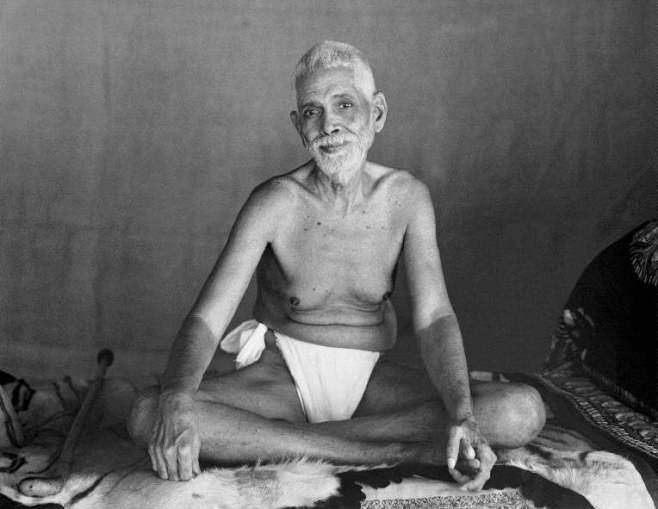
In Brunton’s book, he describes astounding experiences shared with Maharshi, who would meditate for hours a day. According to various biographical sources, it seems that Maharshi had been profoundly moved by an experience he had when he was 16, where he was given an insight into the nature of death. After his mystical revelation, against the wishes of his parents, he travelled from Madurai to Arunachala, where he remained until his death in 1950. He desired no followers, gifts or support, other than donations of food, and spent his younger years in a tiny cave on the mountain. Gradually, this charismatic man soon gained a reputation for his incomparable insights, and a small, basic ashram was built for him, at the base of Arunachala.

Brunton, who had searched across India for men of divine wisdom, finally found Maharshi, and was immediately taken by this great man. What impressed him enormously, was Maharshi’s lack of interest in acquiring disciples of any type. People who shared space with Maharshi, were often touched by some sort of exceptional vibration that would imbue a taste of enlightenment.

This certainly engaged my interest, and I was particularly curious about the manner in which I had ended up in this town. There were so many synchronistic moments that seemed to have some underlying reason for I being here. Of course, it could also be down to chance and coincidence, but the magic of India had intoxicated me with spiritual potentials. Instead of staying only a couple of days, I had to extended my time.

Recently UpdatedWhen I returned to the ashram the next day, I was immediately aware of how simple and small it was, compared to the grandiosity of the other ashrams I had visited. This was not a place designed to impress or convert people; it was rather a humble place of devotion and meditation. Even the Westerners there, seem like a calmer, less phony group. Perhaps, the teachings of Maharshi are so precise that there is no room for the luxury of phoniness.

I must admit, as I sat next to the hall where Brunton had experienced such an overwhelming connection with Maharshi, all those years back in 1932, I felt that this was the closest that I have perhaps ever come to a truly enlightened man, even though he had passed away so long ago.

The motivation that drove Maharshi was entirely selfless and unique, with none of the self-promotion that follows so many gurus. Maharshi’s teachings, as I rudimentarily understand them, are entirely in accordance with the deepest insights to be found in all religions. He does not promote a particular religion, but rather a way forward for attaining happiness. What an honour it was to discover one of those rare lights of humanity.

I later met the Indian man who had been curt with me previously when I arrived, and found him to be charming and informative. Walking around the ashram undisturbed, it gave me enormous pleasure to find the spots where Brunton had experienced incidents so long ago. The calm of that humble ashram will remain forever with me, and I hope that I will once again visit.

Ascending Mount Fuji

Photography by El-Branden Brazil

Photography by El-Branden Brazil

The majestic peak of Mount Fuji represents the Japanese like no other natural feature. This almost perfect volcanic cone stands watch over Tokyo, revealing itself often during the dry winter months.

Whilst not a giant mountain on the scale of the Himalayan peaks, it does measure 3776 meters, so whilst accessible for trekkers, it is high enough that it requires respect.

Between the months of June to September, the mountain opens to people driven to climb to its peak. Other times of year are off limits to anyone other than expert mountaineers; brave enough to face its icy slopes and fierce weather conditions.

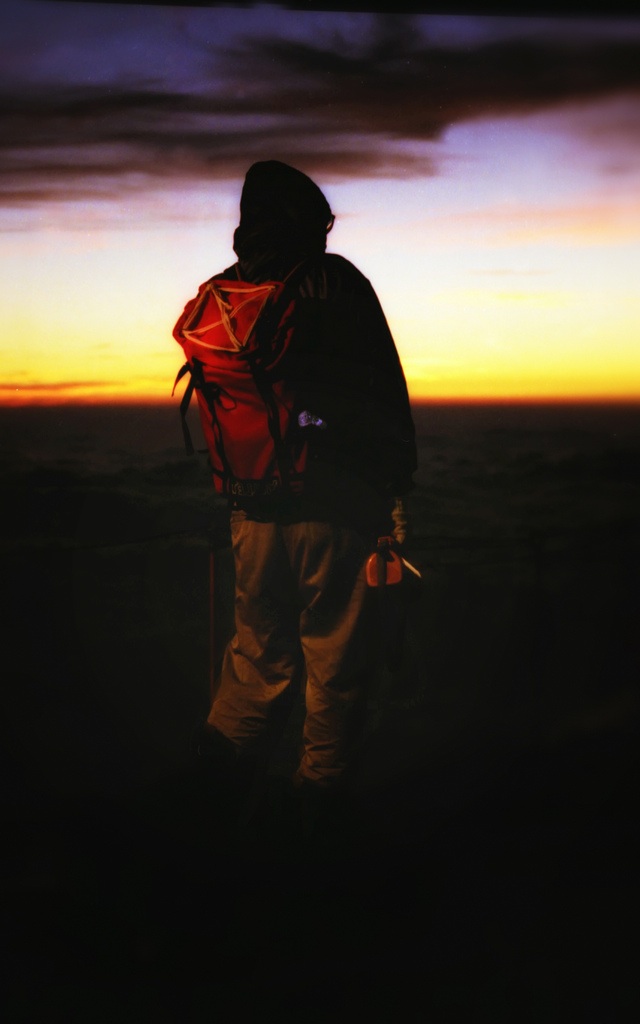
Most summer climbers attempt the challenge during the night, so that the dawn can be witnessed from the summit. Whilst the path leading up is fairly straightforward, it is recommended that all climbers wear sturdy hiking boots with good ankle support, as well as a daypack to carry warmer clothes for the peak, where the temperatures drop enormously from the summer humidity at the base.

Photography by El-Branden Brazil

Photography by El-Branden Brazil

Anyone assuming to scale this mountain with Romantic inclinations of doing so alone, will be sorely disappointed by the caterpillar of well-rigged Japanese hikers, crawling slowly and methodically up. Many of them stay at several of the over-priced, basic lodges that mark each of the nine stages to the top.

As the climber zigzags up to the seventh stage, the path suddenly alters into a more stimulating challenge, that requires clambering up on rocks, using chains to grab on to. The air also becomes thinner and thinner, especially after passing the 3000 meter mark. Some people carry small canisters of oxygen to avert altitude sickness. However, many of these people have finished their canisters well before they were needed.

The climb, whilst popular, is not as easy as many people assume it to be. It is a real mountain that requires stamina and perseverance. There are many who find the challenge too much, and backtrack down disappointed.

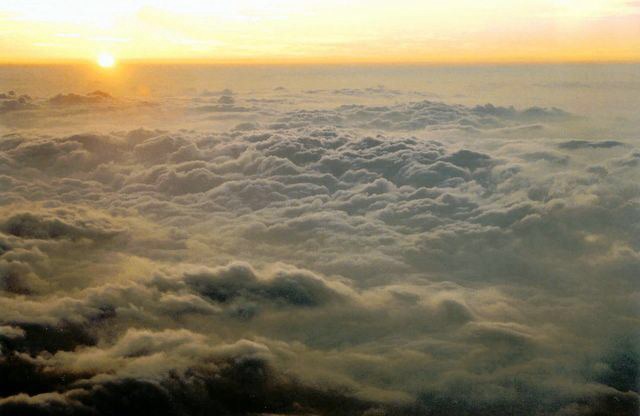
The legs become stiffer and the air cooler, as the night continues on. If the weather conditions are fine, a starlit sky of such clarity accompanies, with the dull blue clouds below, illuminated by the moon. The heart pounds ferociously and the lungs and throat become parched, but those moments of silence among the stars, when rest is called upon, are unforgettable.

Once at the peak, it is a surprise to find a large lodge, offering drinks, noodles and Japanese boiled foods, called Oden. It makes for a comfortable place to linger, whilst waiting for the twinkle of dawn to manifest.

Slowly, the darkness begins to fade, as the Sun begins its ascent upon the horizon. People assemble their cameras, many shaking with the chilling, biting wind. There, breaking above the clouds, a bright shaft of light pushes out. As this happens, everyone shouts out “Banzai! Banzai!”

Very soon, the sky is dominated by the brilliant sun, which illuminates Fuji, revealing the deep crater that leads to the heart of the mountain. In the daytime, the dormant volcano transforms into an entirely different environment, appearing very similar to Mars, with its red rock.

The descent down is the hardest part of the trek. Climbers without walking sticks, find themselves slipping repeatedly on the round, sharp volcanic stones that litter the winding pathway. The Sun also bakes those foolish enough not to bring a hat or sun block.

After a somewhat monotonous climb down, the exhausted climber finally reaches the bus stop, where the coaches come to ferry city dwellers back to the concrete jungle of modern Tokyo.

Photography by El-Branden Brazil

Photography by El-Branden Brazil